
Inside the Fight Against Ebola: A Week with a Head Nurse in Ituri, DRC
As the Ebola spread continues through Ituri province in the Democratic Republic of Congo, a Save the Children-supported head nurse is documenting daily life on the frontlines: the shortages, the heartbreak, and the resolve it takes to keep a health center running in the middle of an outbreak.
Written by: Save the Children | Vlog by: Jules*, Head Nurse, Health Center, Ituri, DRC | Media Contact: Claire Garmirian +1 (203) 209-8545
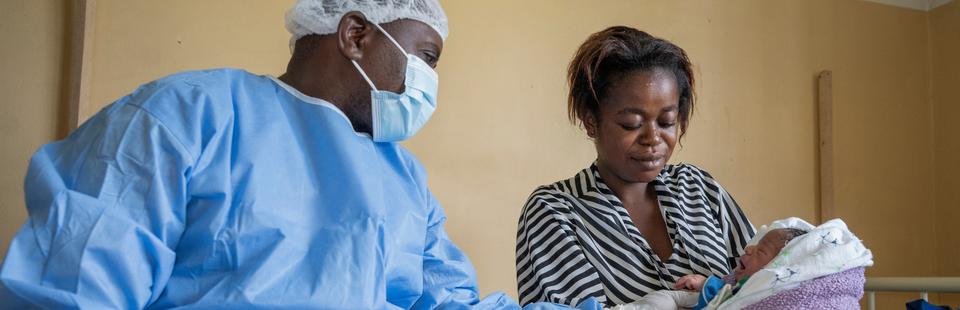
Claudine*, 23, lives in a village in Ituri with her three-year-old daughter. Her husband left home four months ago to work in gold mine to provide the family. During her pregnancy, Claudine* managed alone, balancing farming and small-scale trading of cassava leaves to survive. At five months, she began attending antenatal care (ANC) at a Save the Children-supported health centre, where she was advised to avoid heavy labour and received key services, including vaccinations, malaria prevention, deworming and nutritional support.
After a few hours of labour in May 2026, Claudine* safely delivered her son without complications. Today, Claudine* is grateful for the care she received, which helped her navigate pregnancy safely despite a difficult environment. She thanks Save the Children for providing free healthcare that improves maternal health in her community.
Every morning, Jules* puts on his gown, mask, and gloves before he does anything else. As head nurse at a health center in Ituri, DRC, he is on the frontlines of a growing Ebola outbreak, one that is spreading faster because of conflict, and one his team is fighting with far fewer supplies than they need.
Over the course of a week, Jules recorded a video diary and shared photos from inside his health center, taking us through what day-to-day life looks like in the heart of an outbreak that shows no signs of slowing.
"I'm on my way to work at the health center with a lot of concern, a lot of fear," Jules said. "Why? Because there is a rise in infections. The number of deaths is increasing too. We don't have the means to protect ourselves. We work with very little hope of succeeding."
A Handwashing Station Is the Only Line of Defense
The day begins the same way for every patient who walks through the door: a handwashing station at the entrance. It's one of the only tools available to stop the disease from spreading further, and it isn't always fully stocked.
"The patient flow at the health center is set up by having a handwashing station at the entrance," Jules explained. " So anyone entering the health center must wash their hands."
But basic protective equipment is running low. "There's a shortage of hand sanitizer and other basic personal protection equipment," he said. "If we had access to these supplies, it would help with our confidence to better fight this disease and prevent us from becoming infected."
Routine Care, in the Middle of an Outbreak
Even as the outbreak strains every part of the health center, ordinary care continues. On Day 3, Jules and his team ran a full slate of services for mothers and children.
"We started off by inviting mothers for pre-school consultations," he said. "When they arrived, they all washed their hands and had their temperature checked. After that, we led sessions on health education, then we provided weighing, followed by vaccination. We also provided consultations for patients."
That same commitment extends into the wider community, where Jules and his colleagues work to keep families informed and protected. "We work hard to raise awareness in the community about the importance of washing hands with soap, checking temperatures when visiting the health center, and maintaining a physical distance of one meter when in a group," he said.
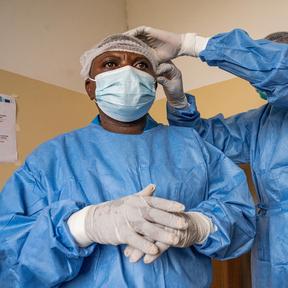
"The situation of war makes response activities difficult," Jules said. "Because when there is a contact case, we are required to monitor it, we must identify it, register it, and follow it for at least 21 days. Now, when conflict breaks out in a village, everyone flees, including the contact cases. This is why you can see cases of infection and the spread of the disease increasing very rapidly."
- Jules, Head Nurse, Ituri Province, DRC
Classrooms of 70 Students with No Ebola Screening
The outbreak response has reached schools too, where handwashing stations have been installed to help protect students. But a critical gap remains.
"We're spreading awareness and delivering health messages in schools," Jules said. "We've also installed handwashing facilities in schools to fight this disease."
Still, without a way to screen students as they arrive, one infection can spread through an entire classroom before anyone realizes it. "What we have not managed to do is set up a triage screening system in schools," Jules said. "Because education is free here, there are more than seventy students in a single classroom. If a child is not isolated as soon as they become a suspected or confirmed case, they can infect an entire class."
Mothers Separated from Their Newborns
Of everything Jules has witnessed this week, one reality has stayed with him the most: mothers with Ebola being separated from the infants they were still breastfeeding, at a moment when their babies need them most.
Jules is worried about what will come next if that support doesn't arrive. Conflict in the region is already making it harder for families to meet their most basic needs, he said, and he fears the consequences for children will only grow.
"At the same time, there's an ongoing conflict and insecurity, which prevents parents and community members from being able to provide for their family needs," Jules said. "This situation is making me so worried, as without support for the health center, it'll be difficult to respond to the needs and concerns. I believe that in the coming days, we will see many cases of children falling into malnutrition, and even cases of premature death."
When Conflict Undoes Ebola Contact Tracing Efforts
Stopping Ebola spread depends on the painstaking process of contact tracing: identifying everyone a sick person has been in contact with, then monitoring them for 21 days. Conflict in Ituri is making that process nearly impossible.
"The situation of war makes response activities difficult," Jules said. "Because when there is a contact case, we are required to monitor it, we must identify it, register it, and follow it for at least 21 days. Now, when conflict breaks out in a village, everyone flees, including the contact cases. This is why you can see cases of infection and the spread of the disease increasing very rapidly."
Despite it all, Jules and his colleagues return to the health center every day. "We keep working despite everything," he said, "despite not knowing if this epidemic can be defeated. Without the support, it will be very difficult."
The Ebola Crisis Is Not Slowing Down
Jules' week offers a rare, direct look at what it takes to respond to an Ebola outbreak while conflict unravels the systems meant to contain it. Ebola spread accelerates when contact tracing breaks down, and families are forced to flee. Protective equipment runs short just as infection rates climb. Health workers are asked to hold a line with fewer resources every day, while mothers, infants, and children pay the heaviest price.
Health workers like Jules are doing everything they can for children and families facing the Ebola outbreak in DRC. But as he made clear throughout the week, they can't do this alone. Sustained support, in the form of protective equipment, breastmilk substitutes, staffing, and funding, is what stands between the current outbreak and a far worse one.
Donate to Help Children in the DRC and Around the World
Save the Children is working in Ituri Province, DRC and around the world to support families impacted by crisis. Your donation today to the Children's Emergency Fund makes this possible. Donate today.