Help Children in Guatemala
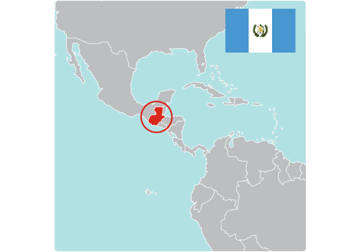
Guatemala, officially the Republic of Guatemala, is a country of striking geographical features, including active volcanoes, and a strong indigenous culture – as well as crushing poverty, violence and unrest. As part of the Northern Triangle, along with El Salvador and Honduras, Guatemala is considered one of the world’s most dangerous places.
Still recovering from a deadly, decades-long civil war that ended in 1996, over half of the population lives below the poverty line – and nearly half of Guatemala’s children under age 5 have stunted growth due to chronic malnutrition, with lifelong consequences. Tragically, the double-digit rate of child homicide is also among the world’s highest.
The indigenous Maya make up about half of the population and are disproportionately affected by the country’s struggles.
In recent years, record numbers of children and families in Guatemala and throughout the region have been driven to flee their homes to seek refuge in the United States. That’s why we’re hard at work addressing the root causes of this crisis within Guatemala.
With the help of caring people like you, we can give Guatemalan children a brighter future.
Challenges for Children in Guatemala
By almost every measure, Guatemala is one of the world’s toughest places to be a child. Suffering from chronic hunger, illiteracy, child labor and extreme violence, Guatemalan children need your help.

1 child in 38 dies before their 5th birthday, 4 times the U.S. rate

47% of children suffer from stunting due to malnutrition

28% of children are out of school, with 26% engaged in child labor

17% of girls (ages 15-19) are married, and 1 in 14 gives birth

10 in every 100,000 children is murdered

59% of people live in poverty
Our Results for Children in Guatemala
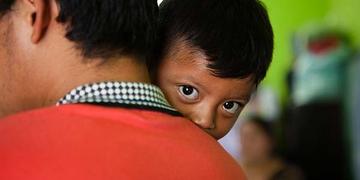
Your support means children like 3-year-old Esbin, here with his father after the Fuego volcano eruption, are sheltered, safe and cared for in times of crisis.

86,000 children healthy and nourished

44,000 children educated and empowered

9,000 children protected from harm

67,000 children lifted from poverty

31,000 children aided in crisis
Our Work for Children in Guatemala
Save the Children has been a leading charity for children in Guatemala since 1999, responding to the needs of children and families affected by 36 years of civil war and a legacy of social, political and economic exclusion, particularly of the indigenous population.
We assist poor, rural, indigenous households through our health and nutrition, education and livelihoods, protection and peace-building programs. When disaster strikes, we respond with the immediate and long-term support children and families need to recover, rebuild their lives and gain resilience to future crises.
In addition, our decades-long presence in Guatemala and experienced staff puts us in a strong position to develop and scale up initiatives to address the root causes of the current migration crisis, assisting children and youth within their communities, as well as those on the move.
Here are some recent examples of our work:
A healthy start in life
- Through our Improving Newborn Survival Project, we’re helping reduce newborn deaths by strengthening health services in hospitals and health centers in places where infants are most at risk, including through Kangaroo Mother Care
- Through our Maternal and Child Survival Program, we have implemented the first-ever cleanliness and infection prevention standards, monitoring systems and improvement guidelines in postnatal care spaces
- We’re helping significantly decrease the prevalence of poverty, hunger and child stunting through our hunger and livelihoods programs
- We’re working to strengthen essential health, nutrition, water and sanitation programs so that children learn to be healthy and are healthy to learn
The opportunity to learn
- We’re helping increase access to quality early child development and bilingual, multicultural education
- Through our Literacy, Education and Nutrition for Sustainability (LENS) program, we’re helping strengthen reading skills, promote healthy behaviors and practices, provide balanced school food programs, and improve school facilities with a focus on water and sanitation
- Our community education model helps prevent the forced or unaccompanied migration of children and adolescents, with significant results
- We’re working to lift families out of poverty by teaching them new skills in livestock management and production, giving girls and boys access to nutritional livestock products and providing families with a sustainable income
Protection from harm
- We’re strengthening our capacity to address migration’s root causes, so that children and adolescents can thrive in the difficult contexts they live in
- We’re assisting with the reintegration of deported children and youth into their communities
- We’re running pilot projects to create “Schools of Peace,” building a protective environment around children and youth
- We developed an information and database system to help with the safe referral of survivors of human trafficking and ensure their access to services
- We also developed a system to enable shelters to better track the status of children who are returned to the country, including monitoring children’s appointments with case workers, health services and the judicial system
How to Help Children in Guatemala
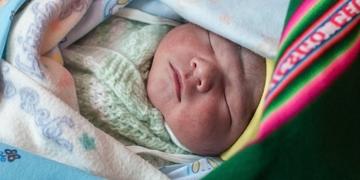
Donate
Support Save the Children’s mission. Donate to help children in Guatemala and around the world grow up healthy, educated and safe.
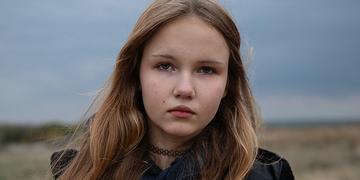
Join Team Tomorrow
Join Team Tomorrow and your monthly donation will go toward addressing the needs of children affected by today’s most urgent issues.
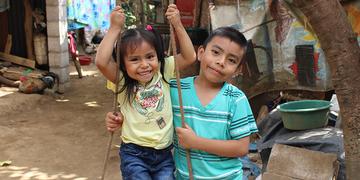
Browse the Gift Guide
Give a meaningful gift that will help transform children’s lives and futures in Guatemala and beyond. There’s something for everyone!
Sources: Facts and statistics have been sourced from Save the Children’s monitoring and evaluation experts, as well as our thought leadership publications, including our Global Childhood Report 2020 and Stop the War on Children 2020 report.
Photos: Save the Children Guatemala.