
Help Children in Vietnam
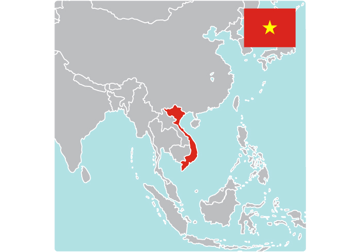
Vietnam is a population-dense, coastal nation in Southeast Asia on the eastern edge of the peninsula known as Indochina, with a decades-long history of warring interests, including U.S. military involvement.
Today’s Vietnam, officially the Socialist Republic of Vietnam, is a one-party Communist state – and one of Asia's fastest-growing economies. However, vast pockets of inequality remain, particularly for hard-to-reach ethnic minorities living in hillside communities. In fact, ethnic minorities account for about 15% of Vietnam’s population, but a staggering 47% of the poor.
Together, we can ensure all children in Vietnam have the childhoods they deserve.
Challenges for Children in Vietnam
Despite progress in reducing child malnutrition, nearly one-quarter of Vietnamese children are stunted – and stunting among ethnic minorities is up to 4 times higher. Vulnerable children in Vietnam’s underserved communities, with limited access to essential health care, education and protection services, need your help.

1 child in 48 dies before their 5th birthday, 3 times the U.S. rate

24% of children suffer from stunting due to malnutrition

10% of children are out of school, with 13% engaged in child labor, instead of learning

10% of girls (ages 15-19) are married, and 1 in 32 girls gives birth
Our Results for Children in Vietnam
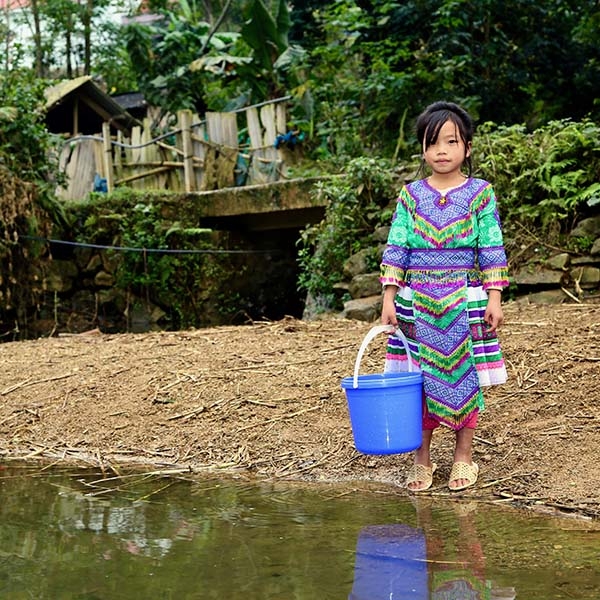
Little Tra, 8 years old, no longer has to fetch heavy bucketfuls of unclean river water, because supporters like you helped us build a well in her village.

7,110,000 children healthy and nourished

179,000 children educated and empowered

64,000 children protected from harm
Our Work for Children in Vietnam
Save the Children has been a leading charity serving the needs of Vietnam’s children since 1990. In 1991, we launched a pioneering program, based on the “positive deviance” approach, to combat crushing child malnutrition in rural Vietnam.
Today, we provide health and nutrition, education and livelihoods, child protection and disaster risk reduction programs, plus emergency response. We work in partnership with government agencies, civil society organizations, the private sector and academic institutions. We are particularly focused on reaching the most vulnerable children, including ethnic minorities and migrant children and their families.
Thanks to the generous support from our community of supporters, these essential programs in Vietnam continue to give children a healthy start and the opportunity to learn, protecting them from harm along the way.
Here are some recent examples of our work:
A healthy start in life
- We’re promoting our Household-to-Hospital Continuum of Care approach to improve health care services for mothers and newborns among ethnic minorities, including through capacity building for midwives and community health workers and providing essential equipment to set up newborn care units
- We’re helping improve children’s nutrition by promoting effective infant and young child feeding practices during the critical first 1,000 days of life
- Through our Alive and Thrive initiative, we’re contributing to increases in food variety for children, using interpersonal counseling, mass media and community mobilization strategies
- We’re improving access to and use of adolescent responsive health services for urban migrant young women and girls
- We’re advocating for collaboration to address child stunting in ethnic minority communities
The opportunity to learn
- We’re supporting early literacy and math skills to strengthen school readiness through developing age-appropriate books and other learning materials for ethnic minority children and building the capacity of teachers, caregivers and parents
- We’re working to ensure equal opportunities in basic education and improving learning outcomes for ethnic minority children through our pioneering multilingual education approach
- We equipped 172 schools with sanitation and kitchen facilities, including latrines, hand-washing stations, first-aid kits, water purifiers, trash bins and kitchen appliances
- Thanks to supporters, we’re conducting teacher training on children with special needs, child safety and inclusive education
- We’re building latrines in schools serving mostly poor ethnic minority families, providing safer, healthier places to learn
Protection from harm
- We’re strengthening and promoting the quality of child protection systems, incorporating prevention, care reform and the capacity to protect children from violence
- We’re campaigning for the elimination of physical and humiliating punishment by promoting positive child discipline at home and in school through child-friendly learning environments
- We set up a monitoring and reporting mechanism on child abuse, discrimination and bullying
- We’re helping parents and young adults use communication to work out their differences and discuss sensitive subjects like early marriage and abuse
Innovation
- We’re creating a virtual reality mobile phone application to help young job seekers gain vocational skills and visualize potential careers, dramatically transforming youth employment opportunities
Emergency response
- We’re providing capacity building on disaster management to affected communities in disaster prone areas
- We’re working with schools on disaster risk reduction activities, such as school risk assessment and risk reduction planning, as well as teaching lifesaving skills
- When disaster strikes, we stand ready to respond
How to Help Children in Vietnam
Donate
Support Save the Children’s mission. Donate to help children in Vietnam and around the world grow up healthy, educated and safe.

Join Team Tomorrow
Join Team Tomorrow and your monthly donation will go toward addressing the needs of children affected by today’s most urgent issues.
Browse the Gift Guide
Give a meaningful gift that will help transform children’s lives and futures in Vietnam and beyond. There’s something for everyone!
Sources: Facts and statistics have been sourced from Save the Children’s monitoring and evaluation experts, as well as our thought leadership publications, including our Global Childhood Report 2020 and A Catalog of Common Approaches 2020. Other sources include: CIA World Factbook and UNICEF.
*Photo credits: Matthew Morrison / Save the Children, 2015, 2016.